Projects

Fire safety training in virtual reality

The TBMouv! Lab at Keolis Bordeaux Métropole Mobilités has developed a fire safety training platform that uses virtual reality. It allows drivers to practice emergency procedures in highly realistic conditions.

Partners

Posted

DEC. 18, 2025

Share on

A major safety challenge for the network

In 2022, the Bordeaux network experienced four fires impacting its buses. While these incidents were managed safely, they highlighted a major safety requirement: the ability of drivers to act quickly and effectively by taking the right actions at the right time.

Traditional training presents certain challenges, including the need to bring multiple people together at a single location to simulate a realistic scenario. This type of training also requires the lighting of a real fire and the deployment of single-use fire extinguishers. In addition to their logistical constraints, these training sessions also remain theoretical. No simulation can reproduce the actual conditions of a real fire aboard a bus or tram, a high-stress situation requiring drivers to respond calmly and without panicking.
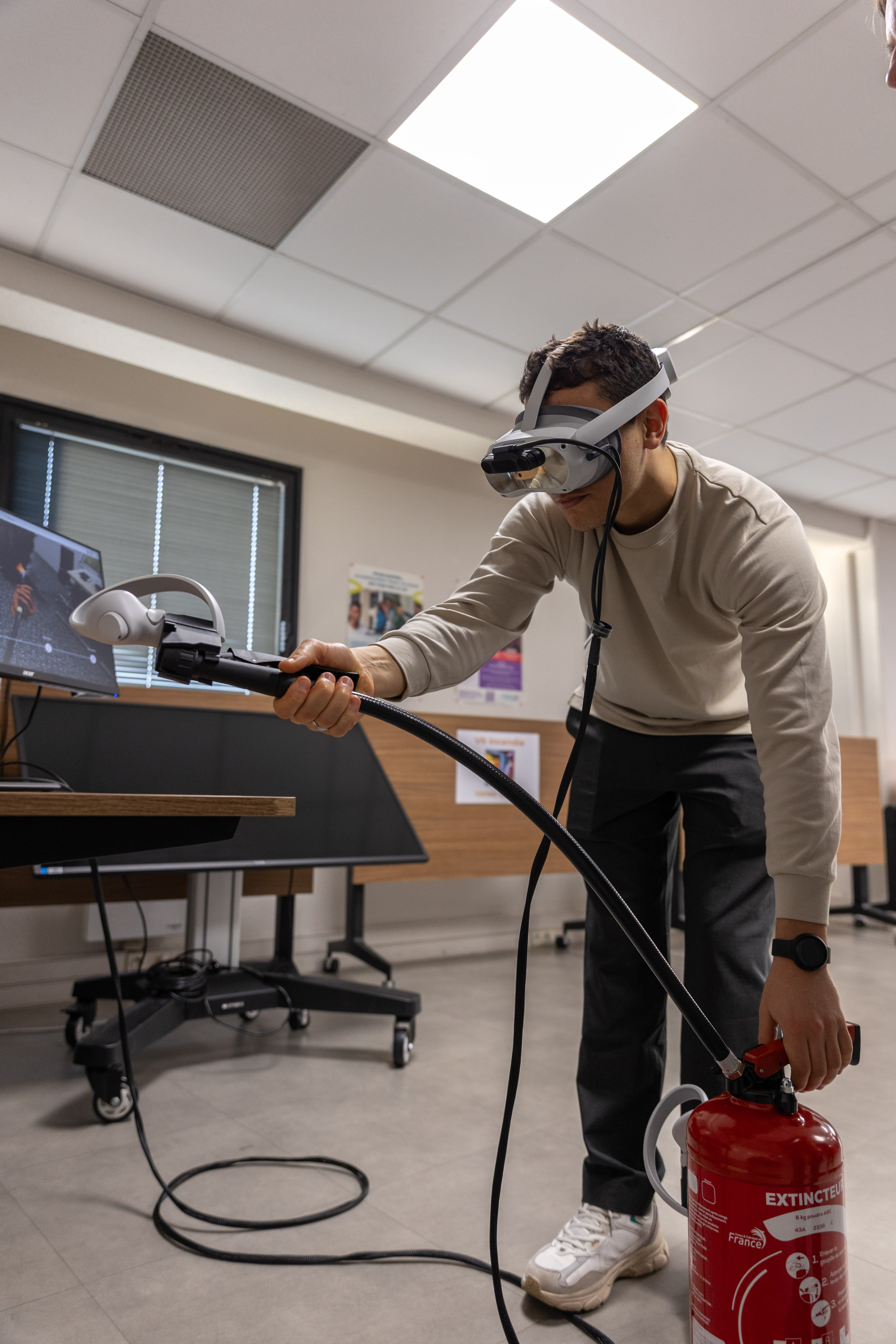

The Lab designed an immersive experience that places employees in ultra-realistic emergency situations.

Full immersion with a VR fire simulation

To improve its training system, the TBMouv! Lab explored virtual reality (VR) technologies. In partnership with Wanadev, a specialist in the field, and Culture Prev, an expert in prevention training, the Lab designed an immersive experience that places employees in ultra-realistic emergency situations.

This process led to a “VR Fire Safety” training, organized in three parts: office, bus and tram.

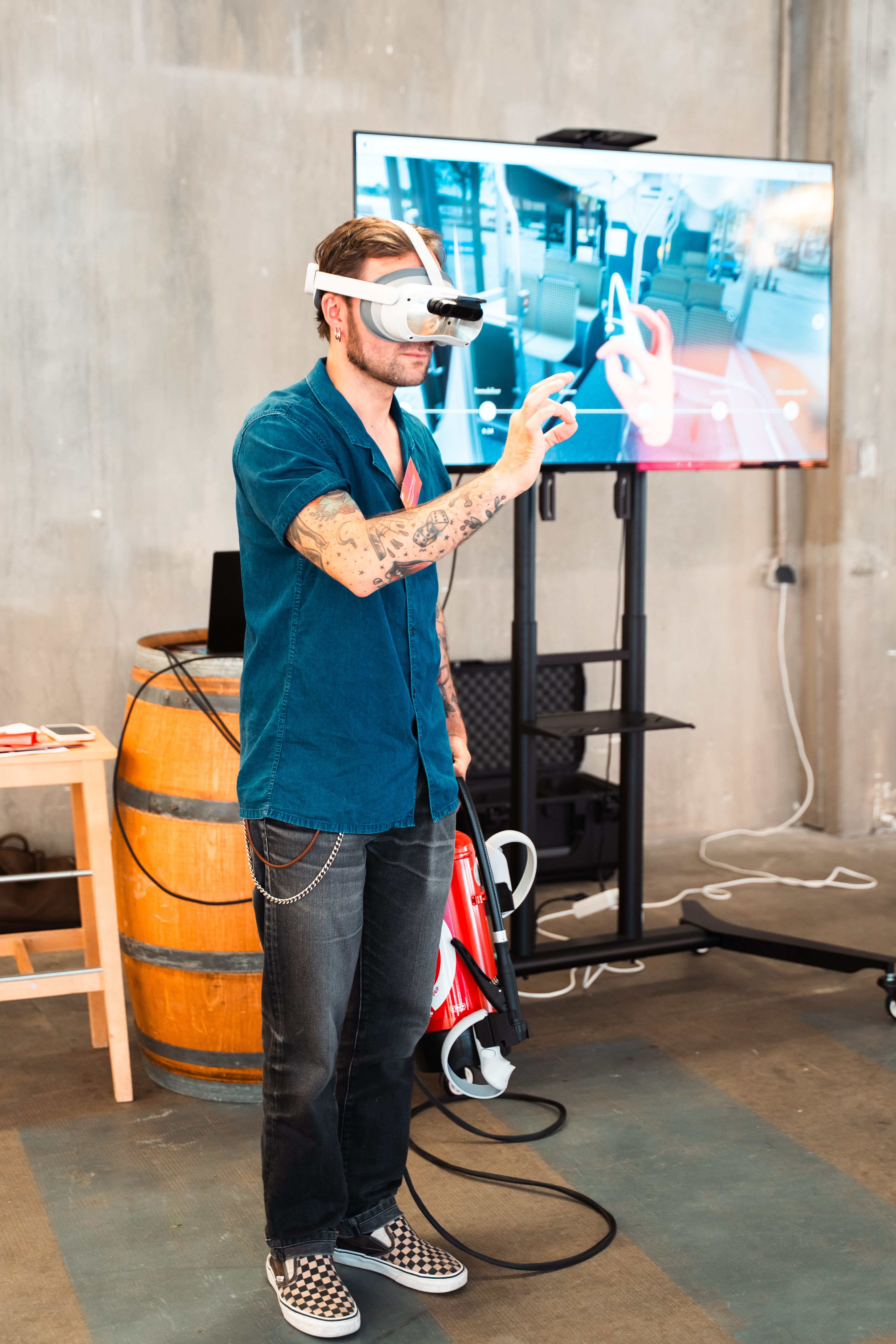
To recreate authentic environments, soundscapes recorded in various rolling stock were integrated into the simulations. As a result, once they put on the virtual reality headset, drivers are fully immersed in a tram car or a bus with passengers and must respond to a fire scenario: directing passengers to evacuate, using a fire extinguisher (a dummy physical prop), extinguishing the fire, etc. The audio and visual effects accurately reconstruct the emergency at hand. Several different scenarios are available: various fire types, an outbreak in various locations in the tram car, and even unexpected obstacles and fires that reignite.

3

simulation modules: office, bus and tram

12

trained instructors

Effective instruction and cost savings

In addition to its educational capability, the VR Fire Safety solution helps to reduce training costs (including the elimination of single-use fire extinguishers) and simplify logistics, as many people can be trained one at a time.

The project also made it possible to work closely with business teams. Julie Barreau, Occupational Health and Safety Manager, offered her expertise on regulatory and management issues surrounding fire risks. Bruno Loubaresse, Training Manager with the HR Department, coordinated learning questions and training leadership. The process of creating the VR Fire Safety training even led to a profound review of the network’s usual procedures.

Sarah Pinel

Sarah Pinel

Innovation Project Manager at the TBMouv! Lab and head of the VR Fire Safety project

"This method, based on gamification, is much more effective than theoretical training. We have received highly positive feedback from trainees."
Once the pilot is validated, the module will be transferred to the HR Department for wide-scale deployment.

Towards a wide-scale deployment

The test phase for VR Fire Safety will continue through 2026, while the TBMouv! Lab team is fully convinced of virtual reality’s merit for training. Once the pilot is validated, the module will be transferred to the HR Department for wide-scale deployment, starting with training the program’s instructors.

Special attention will be paid to change management: VR technology can be more difficult to grasp for agents who are unfamiliar with these tools. That is why every employee, regardless of their experience, will receive support. The commitment of all stakeholders remains the primary key to this project’s success.

Find out more